
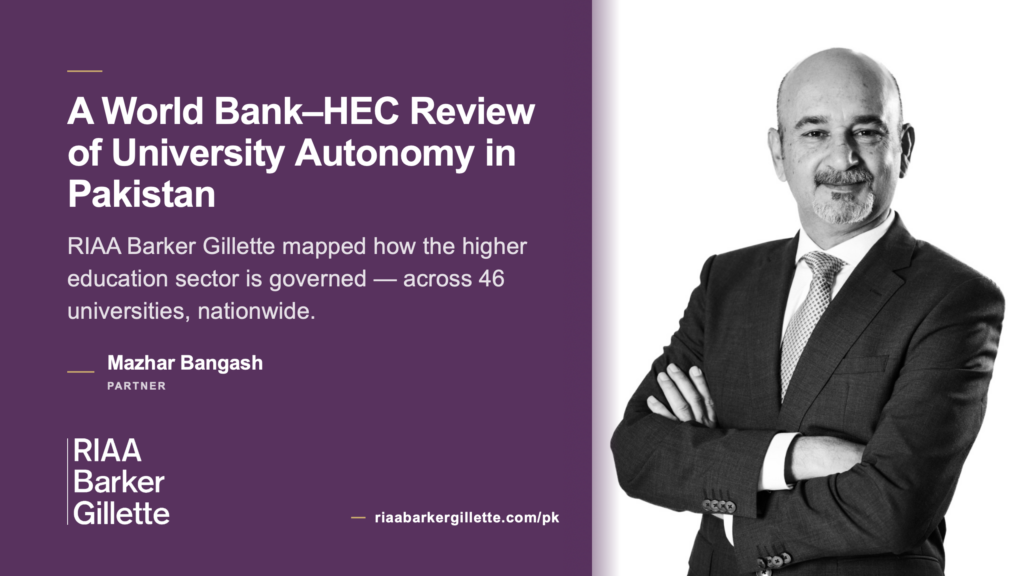
RIAA Barker Gillette has completed a national review of higher education governance in Pakistan. The work formed part of the Higher Education Development in Pakistan (HEDP) project. The Higher Education Commission (HEC) ran the project, with World Bank support. For years, the sector has debated how much independence universities should hold, and how to exercise it well.
At its core, the study assessed the autonomy of Higher Education Institutions (HEIs). In total, the review spanned forty-six universities across the federal territory, all four provinces and the two regions. Together, this sample captured the full diversity of the sector.
For each university, the firm analysed the legal framework, governance structure and decision-making. In particular, it mapped how authority flows across five dimensions of autonomy. These are organisational, financial, staffing, academic and research. Taken together, they revealed both the substantive and the procedural sides of independence. The aim was practical. Where governance worked well, the firm flagged the practices worth copying. Where it fell short, the firm pinpointed the bottlenecks and recommended reform.
Crucially, the review was consultative rather than desk-bound. The firm consulted public and private HEIs, the HEC, the Provincial Higher Education Commissions and the Higher Education Departments. As a result, the framework reflects how the sector truly works, not how it looks on paper.
The real challenge is balance. Effective higher education governance pairs autonomy with accountability. So its recommendations back innovation and stronger performance, without weakening oversight. For the sector, the payoff is universities that can plan, hire and spend with greater confidence.
“The hard part of university reform is rarely the policy — it is the law and procedure beneath it,” said Mazhar Bangash, Partner at RIAA Barker Gillette. “We mapped where authority actually sits, so that any new autonomy carries the accountability to use it well.”
For institutions weighing higher education governance, regulatory reform or institutional structuring, RIAA Barker Gillette offers strategic, sector-aware counsel. The engagement was led by Mazhar Bangash (Partner – Pakistan). The team also included Momin Taufiq (Senior Associate), Saman Shahrukh (Associate) and Ayesha Bashir (Junior Associate).
For more information, contact Mazhar Bangash today.
This article is not legal advice; it provides information of general interest about current legal issues.
…
RIAA Barker Gillette is Pakistan’s premier law firm, with an on-the-ground presence in three major cities in Pakistan: Karachi, Islamabad and Lahore, and affiliated offices in Dubai (DIFC) and London.
The firm practices in all areas of corporate, commercial and dispute resolution law. Leading international legal directories consistently recognise the firm as a top-tier law firm in Pakistan.

RIAA Barker Gillette is the exclusive member firm in Pakistan for Lex Mundi, the world’s leading network of independent law firms with in-depth experience in over 125 countries worldwide.
