
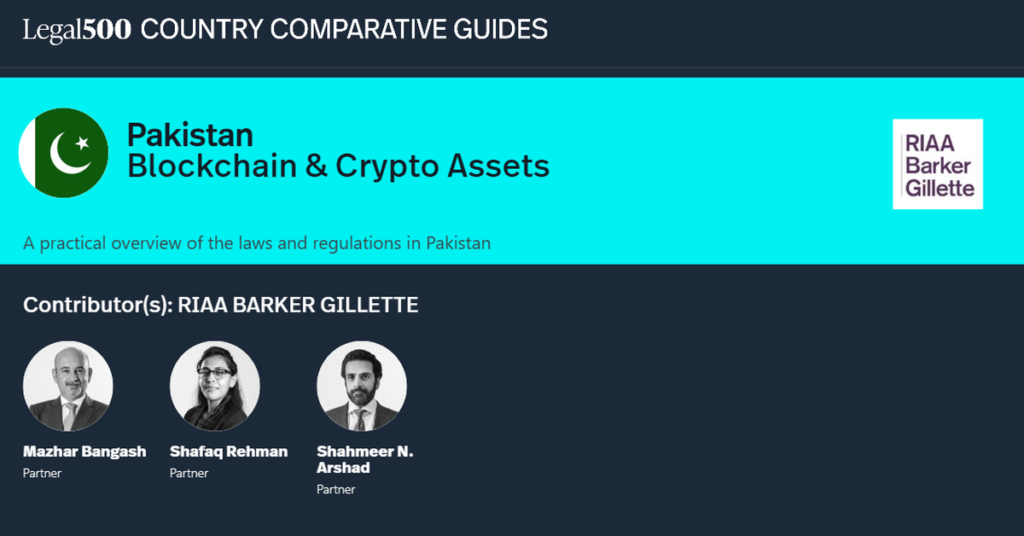
RIAA Barker Gillette authored the Pakistan chapter of the Legal 500 Country Comparative Guides 2026 on Blockchain & Crypto Assets. The chapter sets out the law on virtual assets and the businesses that deal in them. It is timely because Pakistan crypto regulation has moved, since early 2025, from a banking prohibition to a licensing regime in force.
Legislative framework
The chapter explains that the Virtual Assets Act, 2026 is now the principal law. Originally promulgated as the Virtual Assets Ordinance, 2025 in July 2025, the Act passed Parliament in March 2026. It establishes the Pakistan Virtual Assets Regulatory Authority (PVARA) as an autonomous federal regulator. Under the Act, virtual assets are lawful to own and trade but are not legal tender.
Licensing and capital
Only a company incorporated in Pakistan may hold a PVARA licence to provide virtual asset services. PVARA notified the Pakistan Virtual Asset Services Regulations, 2026 and the Activity Specific Regulations on 21 August 2026. The chapter sets out the ten licence categories and the route from No Objection Certificate (NOC) to full licence. Minimum paid-up capital ranges from PKR 15 million for advisory services to PKR 500 million for exchanges. Existing operators had until 5 September 2026 to apply or cease operations.
Banking access
The chapter also covers the change of position at the State Bank of Pakistan (SBP). In April 2026, BPRD Circular Letter No. 10 of 2026 replaced the 2018 circular barring banks from facilitating crypto transactions. Banks may now open accounts for licensed virtual asset service providers, subject to enhanced due diligence and segregation of client funds. However, they may not trade or hold virtual assets themselves.
Tokenisation and token offerings
The Act recognises asset-referenced tokens, which must be fully backed and may reference real estate, commodities or securities. Initial virtual asset offerings require PVARA approval. Where a token is a security, the Securities and Exchange Commission of Pakistan (SECP) retains jurisdiction.
The chapter notes that tokenising real estate does not displace the law on title to land. A project therefore needs an issuance licence, PKR 300 million of paid-up capital and coordination with land authorities.
“Tokenising real estate is now permitted, but title to land still passes under ordinary property law,” commented Shahmeer N. Arshad (Partner – Pakistan) at RIAA Barker Gillette.
Unsettled questions
The chapter also identifies where Pakistan crypto regulation remains incomplete. No dedicated tax regime exists, so gains and mining income fall under the general provisions of the Income Tax Ordinance, 2001. Pakistani law does not yet settle whether crypto assets are property that can be transferred or charged as security.
Similarly, there is no reported case law on smart contracts or decentralised autonomous organisations. Finally, PVARA has approved the Regulatory Sandbox Guidelines, 2026 but has not yet notified them.
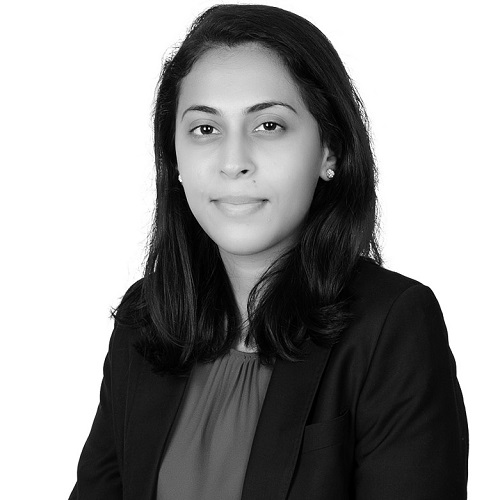
“The licensing framework is in force, but Pakistani property, tax and insolvency law does not yet address virtual assets,” commented Shafaq Rehman (Partner – Pakistan) at RIAA Barker Gillette.
For a full account of Pakistan crypto regulation, read the Pakistan chapter of the Legal 500 guide.
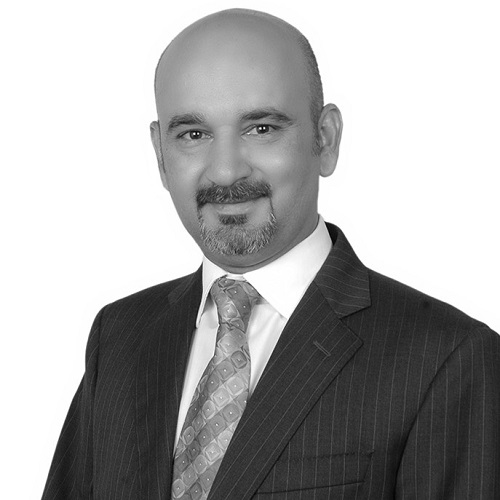
For more information on virtual asset regulation in Pakistan, contact Mazhar Bangash, Shafaq Rehman and Shahmeer N. Arshad.
This article is not legal advice; it provides information of general interest about current legal issues.
…
RIAA Barker Gillette is Pakistan’s premier law firm, with an on-the-ground presence in three major cities in Pakistan: Karachi, Islamabad and Lahore, and affiliated offices in Dubai (DIFC) and London.
The firm practices in all areas of corporate, commercial and dispute resolution law. Leading international legal directories consistently recognise the firm as a top-tier law firm in Pakistan.

RIAA Barker Gillette is the exclusive member firm in Pakistan for Lex Mundi, the world’s leading network of independent law firms with in-depth experience in over 125 countries worldwide.
