

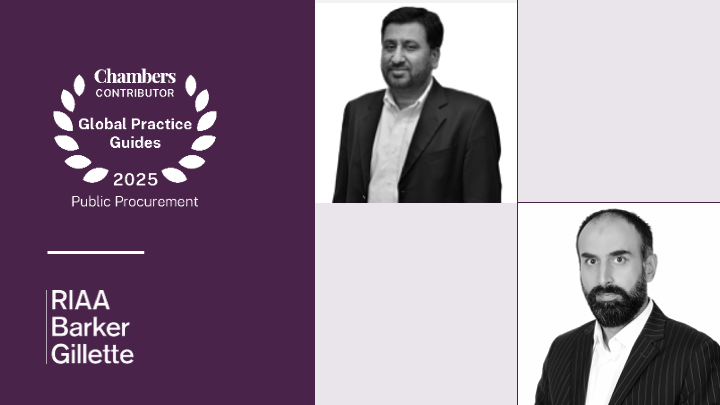
RIAA Barker Gillette authored the Pakistan chapter of the Chambers Global Practice Guide: Public Procurement 2025, providing essential guidance on Pakistan public procurement law for businesses and legal professionals. The comprehensive guide provides an in-depth examination of the legal and regulatory framework governing public procurement at both federal and provincial levels in Pakistan.
The chapter explores Pakistan’s dual regulatory structure, with federal procurement governed by the Public Procurement Regulatory Authority Ordinance 2002 and the Public Procurement Rules 2004, while each province maintains its own distinct procurement laws and regulations. This multi-tiered approach creates unique challenges and opportunities for bidders, particularly as thresholds, timelines, and procedural requirements vary significantly across jurisdictions.
Key topics covered include the various tender procedures permitted under Pakistan public procurement law, from single-stage bidding to complex two-stage processes suitable for technically challenging projects. The guide provides detailed analysis of when procuring agencies may resort to direct contracting, including emergency situations and sole-source procurements, while emphasizing the strict conditions and approval requirements that apply. The chapter also examines transparency obligations, including mandatory standstill periods and the requirement to announce evaluation results at least 15 days before contract awards.
“The procurement landscape in Pakistan has evolved significantly, with courts increasingly scrutinising compliance with procedural requirements,” observed Hasnain Naqvee, Senior Partner at RIAA Barker Gillette (Pakistan). “Recent decisions have reinforced that even partial execution cannot validate contracts awarded through non-transparent means, making strict adherence to procurement rules essential.”
The guide provides crucial insights into Pakistan’s grievance redressal mechanism, outlining how bidders can challenge procurement decisions through Grievance Redressal Committees and the appeal process to the PPRA. Recent landmark court decisions analysed include cases establishing that past litigation cannot grounds for pre-bid exclusion and affirming procuring agencies’ discretion to reject all bids with proper justification.
“This guide is particularly timely as Pakistan reviews its procurement framework, with draft Public Procurement Rules 2024 introducing sustainable procurement provisions and enhanced contract management requirements,” added Bilal Shaukat, Managing Partner at RIAA Barker Gillette (Pakistan). “These reforms signal a shift toward international best practices in public procurement.”
The chapter addresses practical considerations including advertisement requirements based on contract values, minimum response times for national versus international bidding, and the special prerogatives of procuring agencies. With Pakistan’s ongoing regulatory reforms and increasing judicial oversight, this guide serves as an indispensable resource for navigating the evolving procurement landscape.
For expert guidance on Pakistan’s public procurement regulations, contact Bilal Shaukat or Hasnain Naqvee today.
This article is not legal advice; it provides information of general interest about current legal issues.
…
RIAA Barker Gillette is Pakistan’s premier law firm, with an on-the-ground presence in four major cities in Pakistan: Karachi, Islamabad and Lahore and affiliated offices in Dubai (DIFC) and London.
The firm practices in all areas of corporate, commercial and dispute resolution law. Leading international legal directories consistently recognise the firm as a top-tier law firm in Pakistan.

RIAA Barker Gillette is the exclusive member firm in Pakistan for Lex Mundi, the world’s leading network of independent law firms with in-depth experience in over 125 countries worldwide.
