
The 19th-century lawyer would find things pretty much as they were if they time-travelled to 2017, but a major change to how people can say what should happen after their death will likely happen soon. If the proposals from the Law Commission get the go-ahead, the law is likely to catch up with technology, and in future, we could see emails and other simple expressions of intention being acceptable.
But in the meantime, the only way to be sure of what happens after you die is to make your Last will and testament following the formalities that have been in place for hundreds of years. That is particularly important for those who may be living with partners, for whom the current law offers no protection, or where there are young children, for whom the choice of guardians may be important. Yet it’s estimated that around 40% of adults don’t have a last will and testament.
To be valid, a will must be in writing and signed by the person making the will in the presence of two or more witnesses, who must also sign simultaneously.
Without a valid will, the division of assets is decided by the Intestacy Rules under which, typically, the whole of the estate of someone who dies leaving no surviving spouse or civil partner will go to children, or if they have none, to parents or other family members. If there is a surviving cohabitee, they could apply for “reasonable financial provision” under the Inheritance (Provision for Family and Dependants) Act 1975, but this is a very slow and potentially expensive option. In the meantime, they may be blocked from living in the couple’s home if it is not held in shared ownership.
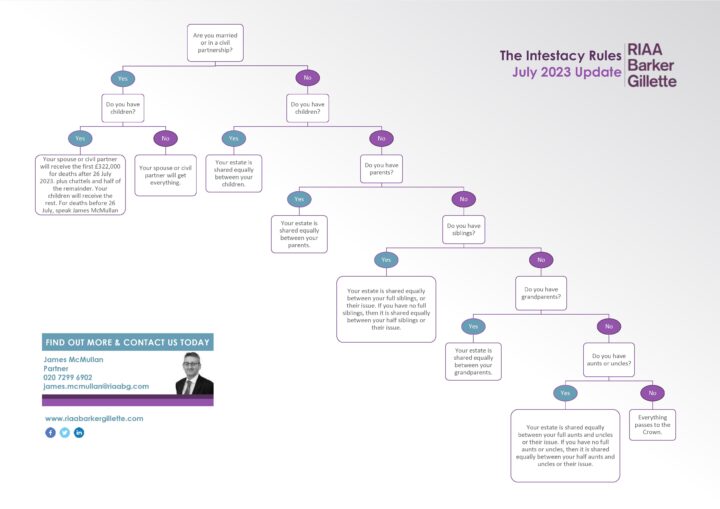
For a larger copy of the above image, click here.
The main proposal from the Law Commission would see the Courts able to recognise wills that have not followed the existing strict rules, so long as the deceased’s testamentary intentions are clear. That will include provisions to recognise electronic wills if fraud and undue influence can be ruled out. It is also intended that new rules would better consider conditions such as dementia, which affect decision-making.
James McMullan, our trust and estate law specialist, said:
“If these proposals go ahead, it will bring the law relating to will writing into the modern world, which is good news if there is sufficient protection, particularly for the older people and vulnerable clients. But nothing is going to change right away, and even if the rules do change there is likely to be a period of uncertainty during which any ambiguities in the new rules are tested in the courts, so for the time being it’s important that wills comply with the long-standing rules. Not having a valid last will and testament in place can create a lot of stress for surviving family, at what is already a very difficult time.
Making a last will and testament is something that people often put off, perhaps because they find it hard to think about, but it’s the only way you can be sure of what happens when you die, and there are issues that will be important at different stages of life. If you have children under 18, it’s likely you would want to have named guardians to care for them, or to make special provision if a child of any age has limiting physical or mental health issues. Older people may want to make plans to mitigate inheritance tax, and cohabiting couples may want to ensure property or assets pass to each other, as they do not have the protection that comes with marriage or civil partnership.”
The consultation period will run until 10 November 2017.
Note: This is not legal advice; it provides information of general interest about current legal issues.